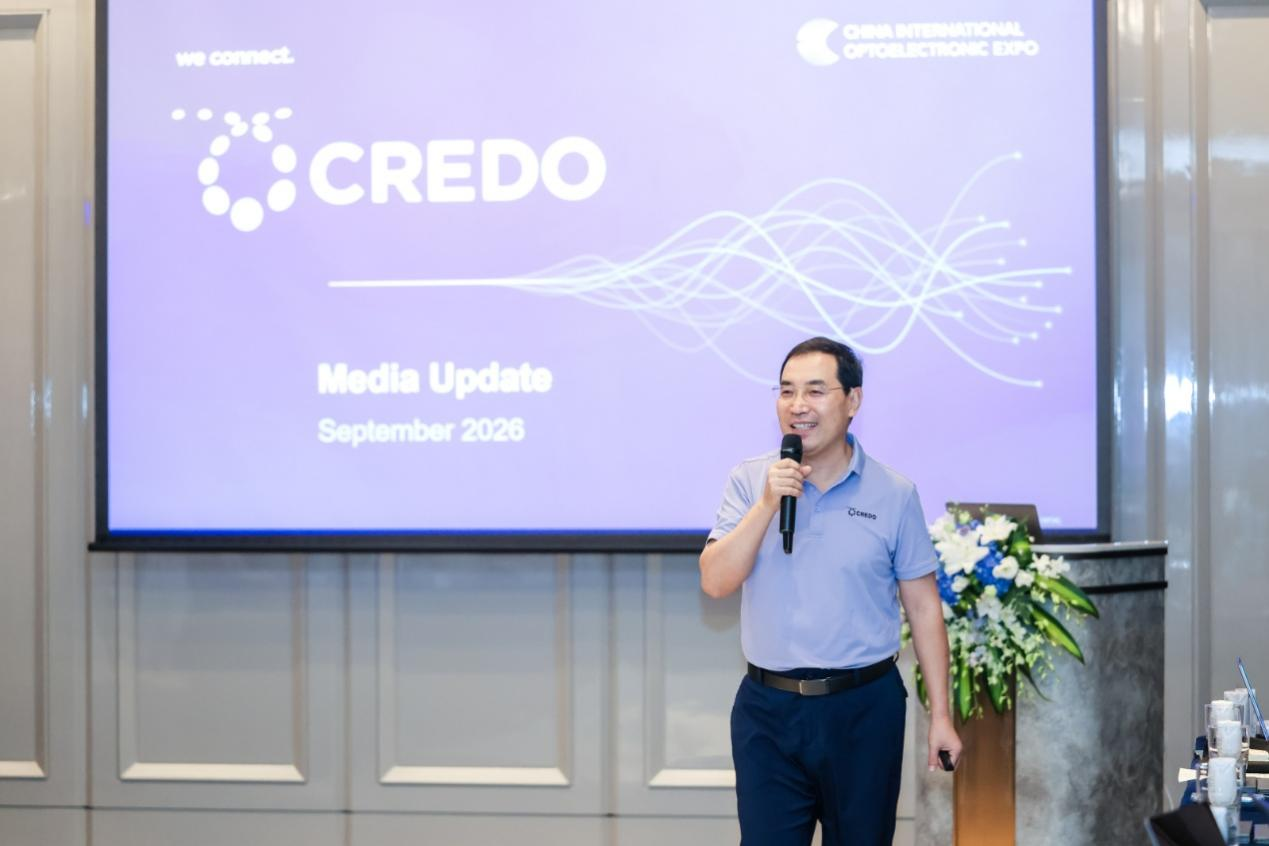
深圳,2026年9月8日 —— 高速互联解决方案提供商 Credo(纳斯达克:CRDO)在中国国际光电博览会(CIOE)期间于深圳举办专场媒体交流会。Credo 管理团队就扩展高速 AI 网络所面临的现实挑战进行了讨论,并介绍了帮助客户满足日益增长的带宽、能效和可靠性需求的关键互连技术。会上 Credo就系统级互联战略向媒体进行了介绍,对外展示其oDSP、硅光子、ZeroFlap有源电缆(AEC)、及OmniConnect Weaver内存扇出解决方案。
Shenzhen, September 8, 2026 – Credo Technology Group Holding Ltd (Credo) (NASDAQ: CRDO), an innovator in providing connectivity at scale through fast, reliable, and energy-efficient system solutions, held a special media event in Shenzhen in conjunction with the China International Optoelectronic Expo (CIOE). Credo executives discussed the real-world challenges of scaling high-speed AI networks and the interconnect technologies that are helping customers meet the growing demands for bandwidth, power efficiency, and network reliability. The Company briefed the media on its system-level strategy, showcasing optical DSPs, Silicon Photonics, ZeroFlap Active Electrical Cables (AECs) and OmniConnect Weaver memory fanout gearbox solutions..
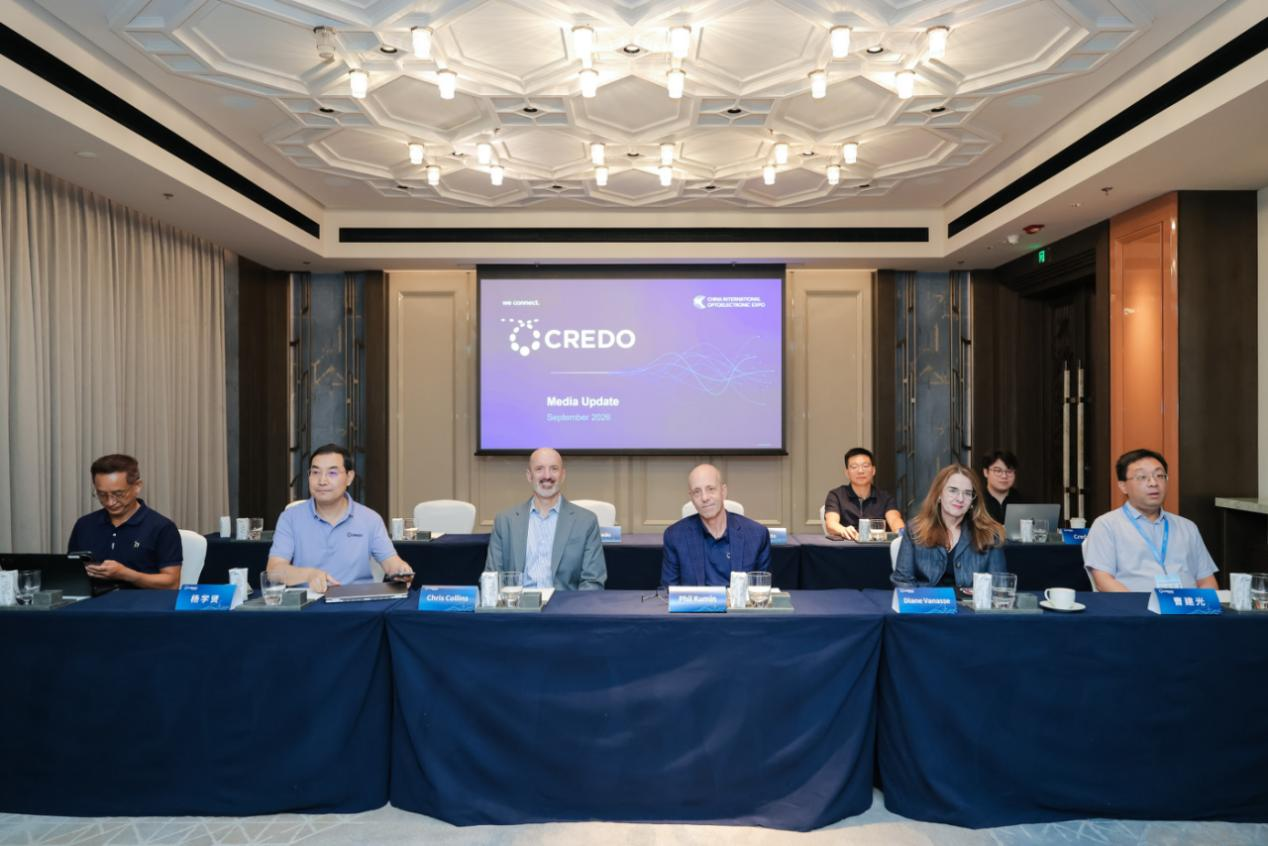
Credo管理团队阐述面向AI网络的 2.0 系统级互联战略
Credo Leadership Introduces 2.0 System-Level Strategy for AI Networks
随着 AI 模型和工作负载规模不断扩大,行业的关注点已从单个 GPU 的性能,扩展到连接大型 AI 集群的网络本身。随着部署规模从数十个 GPU 发展到数百乃至数千个 GPU,在集群内高效传输数据的能力变得愈发重要。因此,能够提供低时延、高可靠性并支持规模化部署的高性能互联技术,已成为支撑下一代 AI 基础设施的关键。
As AI models and workloads continue to grow in scale, industry focus has expanded beyond individual GPU performance to the networks that connect large AI clusters. As deployments evolve from tens to hundreds and thousands of GPUs, the ability to efficiently move data across the cluster has become increasingly important. As a result, high-performance interconnect technologies that deliver low latency, high reliability, and scalable deployment have become critical to enabling the next generation of AI infrastructure.
Credo 中国区销售副总裁杨学贤在会上表示,这一产业变革也推动 Credo 从芯片厂商升级为系统级互联解决方案提供商——即 Credo的“2.0 战略”。
Simon Yang, Credo China Region Sales Vice President, stated at the event that this industry transformation has also driven Credo to evolve from a chip vendor to a provider of system-level interconnect solutions — what Credo calls the 2.0 strategy.
Credo 已于9月1日发布其2027财年第一季度财务业绩。公司拥有逾24 家一流的头部客户,连续多个季度保持快速增长,市场份额持续提升。公司全球员工规模快速增至1000 人,其中大中华区是全球业务布局与AI生态系统中具有战略意义且至关重要的一环。中国大陆及中国台湾地区员工约占公司总人数一半,上海、武汉、南京和香港均设立团队,构建了完整的本地化研发、销售与技术支持体系。
Credo announced its first quarter of fiscal year 2027 financial results on September 1. The company serves more than 24 tier-1 flagship customers, has maintained rapid growth for multiple consecutive quarters, and continues to gain market share. The company's global workforce is rapidly approaching 1,000 employees, with the Greater China region a strategic and critical component of its global footprint and AI ecosystem. Employees in China and Chinese Taiwan account for approximately half of the company's total headcount, with teams established in Shanghai, Wuhan, Nanjing, and Hong Kong, building a complete localized R&D, sales, and technical support ecosystem.
在过去 12 个月,Credo 完成两笔关键收购:收购 Hyperlume 以拓展 Micro-LED 新型光源技术以及收购以色列硅光企业 DustPhotonics以 补齐基于硅光的光子集成电路(PIC)能力。通过自研 加收购,Credo 已打通从 SerDes IP、DSP 芯片、硅光芯片,到有源电缆 AEC、ZeroFlap 光模块,再到 PILOT 链路监控软件的全栈能力,真正实现垂直整合,成为业内少数可以覆盖 AI 数据中心全部互联链路的厂商之一。
Over the past 12 months, Credo completed two strategic acquisitions: acquiring Hyperlume to expand Micro-LED next-generation light source technology, and acquiring Israeli silicon photonics company DustPhotonics to bolster silicon photonics-based PIC (photonic integrated circuit) capabilities. Through in-house development plus these acquisitions, Credo has built out full-stack capabilities spanning SerDes IP, DSP chips, Silicon Photonics chips, active electrical cables (AECs), ZeroFlap optical transceivers, and PILOT link monitoring software — achieving true vertical integration, and becoming one of the few vendors in the industry capable of covering the entire interconnect chain in AI data centers.
Credo oDSP产品线负责人 Chris Collins 详细解读了公司 oDSP 完整产品家族。Credo 已经迭代七代 DSP,覆盖 50G/lane、100G/lane、200G/lane 速率。针对当前行业普遍面临的供应挑战,Credo 的 Robin 800 系列则通过架构优化结合成熟工艺,实现与前代 Lark 产品相当的功耗与性能表现,更优的性价比。该DSP集成了EML 激光驱动器,封装尺寸进一步缩小,同时支持 Full DSP 与 LRO(线性接收光模块)两种架构,既有助于缓解上游供应链产能约束,也让客户对长期持续供货更有信心。
Chris Collins, who leads Credo’s Optical DSP product line, provided a detailed overview of the company's complete optical DSP product portfolio. Credo has iterated through seven generations of DSPs, covering 50G/lane, 100G/lane, and 200G/lane speeds. Addressing the industry-wide challenge of supply constraints, Credo's Robin 800 series leverages architecture optimization with established process technology to deliver power and performance comparable to the previous-generation Lark products. The DSP includes EML laser drivers, with a reduced package size, while supporting both Full DSP and LRO (Linear Receive Optical) architectures, helping mitigate upstream supply constraints while providing customers with greater confidence in long-term supply continuity.
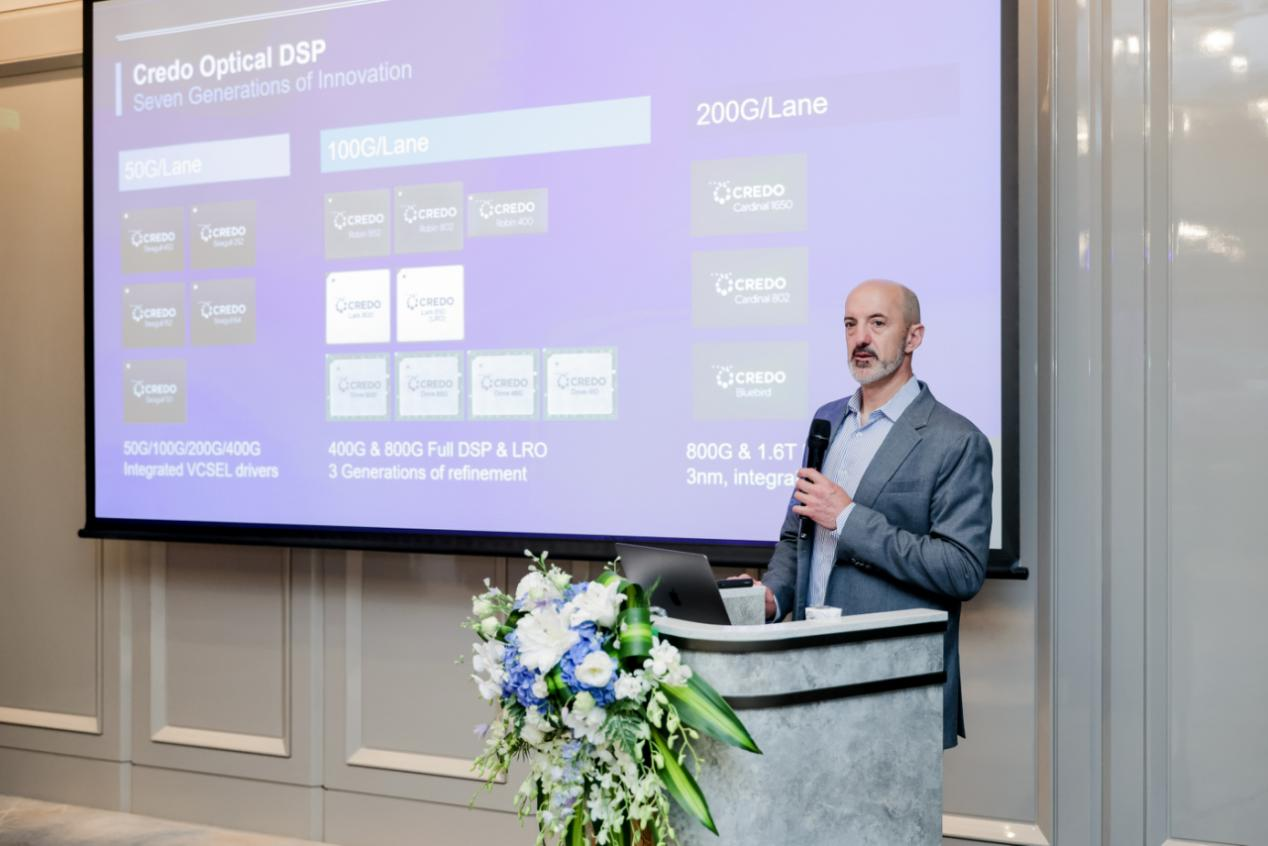
Credo销售与光产品市场营销副总裁 Chris Collins 解读公司 DSP 产品系列
Chris Collins, Associate VP of Credo Optical Marketing, DSP Product Portfolio
面向 1.6T 时代,Credo 推出了Cardinal 系列oDSP。区别于行业普遍的8 通道单Die方案,Cardinal 系列提供 4 通道和8 通道两类 Die选项:Cardinal 802(4×200G)兼顾 800G、1.6T 两种场景;面向 LRO 路线,Credo分别推出 Cardinal 852(4 通道发射端)和Cardinal 1650(8 通道发射端),兼顾 800G 与 1.6T LRO 市场,给客户带来更高的设计灵活性。同时 Credo 正在积极推进其下一代448G/lane DSP技术,以满足未来高速互联的需求。
For the 1.6T era, Credo has introduced the Cardinal series of optical DSPs. Differentiating from the industry's common 8-channel single-die approach, the Cardinal family offers two die options: 4-channel and 8-channel. The Cardinal 802 (4×200G) serves both 800G and 1.6T scenarios; for the LRO route, Credo has launched the Cardinal 852 (4-channel transmit) and Cardinal 1650 (8-channel transmit), addressing both 800G and 1.6T LRO markets to provide customers with greater design flexibility. Credo is actively advancing its next-generation 448G/lane DSP technology to address future high-speed interconnect requirements.
依托 Dust Photonics 技术沉淀,Credo 带来完整硅光子产品矩阵,包括集成光源的硅光引擎与无集成光源标准 PIC 芯片。其自研 L3C 低损耗激光耦合技术是其核心差异化优势,可兼容市面主流商用激光器,以更少激光器点亮多通道,降低模块整体功耗与 BOM 成本。该技术同样支持 NPO(近封装光学)和CPO( 共封装光学)的未来演进路线,支持 16 通道、32 通道等高通道数 PIC 开发,并且支持大规模量产与浸没式冷却应用场景。
Leveraging Dust Photonics' technology heritage, Credo presents a complete portfolio of silicon photonics products, including silicon photonic engines with integrated light sources and standard PIC chips without integrated light sources. Its in-house developed L3C low-loss laser coupling technology represents a core differentiator, compatible with mainstream commercial lasers on the market, illuminating multiple channels with fewer lasers to reduce overall module power consumption and BOM costs. This technology also supports future evolution paths for NPO (Near Package Optics) and CPO (Co-Packaged Optics), enabling development of high-channel-count PICs (16-channel, 32-channel, etc.), and supports mass production and immersion cooling applications.
"DSP 与硅光并不是简单两颗芯片叠加,二者的协同联合优化才是价值核心。"Chris Collins 表示。Credo 实现 oDSP、硅光 PIC、固件联合调测,器件接口提前完成适配,减少客户跨厂商联调周期,缩短产品上市时间。当面临新挑战或产生新应用需求时,客户仅需对接 Credo团队定位问题;同时双方技术路线图保持同步迭代,从 100G/lane、200G/lane 演进到未来 400G/lane,持续为客户提供完整解决方案。
"DSP and silicon photonics are not simply two chips stacked together — the synergistic co-optimization of the two is where the core value lies," said Chris Collins. Credo achieves joint tuning and testing of its optical DSP, silicon photonics PIC, and firmware, with device interfaces characterized upfront to reduce cross-vendor integration cycles and shorten time-to-market. When new challenges arise and new applications are needed, customers need only engage a single Credo team to troubleshoot; meanwhile, both technology roadmaps remain synchronously iterated, evolving from 100G/lane and 200G/lane to future 400G/lane, continuously delivering complete solutions to customers.
会上,Credo 也重点介绍了其 ZeroFlap 产品家族,包含 ZeroFlap AEC 有源电缆以及 ZeroFlap 光模块。依托 DSP 内部专属 IP 以及 PILOT 遥测软件,ZeroFlap 方案可以同时对光链路、电链路进行实时监测,提前预判链路劣化风险;即使发生突发链路故障,系统也可完整记录故障前链路状态,帮助运维人员定位根因,显著提升AI 集群互联可靠性,非常适合 Scale‑Up 纵向扩展 AI 集群场景。
At the event, Credo also highlighted its ZeroFlap product family, which includes ZeroFlap AECs (Active Electrical Cables) and ZeroFlap optical transceivers. Leveraging dedicated IP embedded in the DSP and PILOT telemetry software, the ZeroFlap solution enables real-time monitoring of both optical and electrical links, enabling proactive prediction of link degradation risks; even in the event of sudden link failures, the system can fully record pre-failure link states to help operations personnel pinpoint root causes, significantly improving AI cluster interconnect reliability — making it ideally suited for Scale-Up (vertical expansion) AI cluster scenarios.
针对 AI 推理领域广泛遇到的 "内存墙" 行业难题,Credo 展示其 OmniConnect 架构以及 Weaver芯片方案。这套方案通过外接 LPDDR 内存,在实现接近 HBM 带宽的同时,获得数倍于 HBM 的内存容量,为 AI 推理场景提供全新的内存扩容路径。
Addressing the "memory wall" challenge widely encountered in AI inference, Credo showcased its OmniConnect architecture and Weaver chip solution. This solution leverages external LPDDR memory to achieve bandwidth approaching HBM while delivering multiple times the memory capacity of HBM, providing a completely new memory expansion path for AI inference scenarios.
针对LPO 技术路线, Credo 已经做好充分准备,但同时也看到,随着单通道速率持续提升,去掉 DSP 之后,信号均衡、器件损伤补偿、长通道补偿等能力缺失,LPO 在不少链路场景落地会面临严峻技术挑战,客户需要结合实际场景例如在发射端集成 DSP 的 LRO 方案, 理性评估技术选型。
Regarding the LPO (Linear Drive Pluggable Optics) technology route that has generated significant industry discussion, Credo already possesses a complete LPO DSP and silicon photonics product portfolio, and is fully prepared should the market embrace large-scale deployment. However, it must also be objectively acknowledged that as per-lane speeds continue to increase, the removal of DSP results in the loss of capabilities such as signal equalization, component impairment compensation, and long-channel compensation — meaning LPO will face significant technical challenges in many link scenarios. Customers need to rationally evaluate technology choices, such as LRO where a DSP is in the transmit path, based on their specific application scenarios.
在媒体问答环节,Credo 高管还就供应链保障、封装测试瓶颈、友商差异化、销售组织架构、中国市场战略、AI 市场增长前景等热点话题与媒体展开深度交流。Credo 高管谈到,尽管市场存在关于 AI 泡沫的讨论,但从一线云厂商反馈看,不少头部客户已签署长期业务合约,锁定算力、土地与电力资源。Credo 看好未来数年 AI 互联产业发展机遇,公司正在积极扩充产能与团队,匹配市场长期增长需求。
During the media Q&A session, Credo executives engaged in in-depth discussions with media on hot-topic issues including supply chain assurance, packaging and testing bottlenecks, competitor differentiation, sales organization structure, China market strategy, and AI market growth prospects. Credo executives noted that despite market discussions about an AI bubble, frontline customer feedback indicates that many tier-1 cloud providers have already signed long-term business agreements, locking in compute, land, and power resources. Credo is optimistic about AI interconnect industry growth opportunities over the coming years and is actively expanding production capacity and team to match long-term market growth demands.
中国市场在 Credo 全球业务版图占据极高战略地位。Credo oDSP 业务相当一部分营收来自国内合作伙伴;伴随国内本土 GPU 厂商快速崛起,OmniConnect 内存互联方案在中国同样具备巨大市场机会。
The China market occupies a strategically vital position in Credo's global business footprint. A significant share of Credo's optical DSP business revenue comes from domestic partners; accompanied by the rapid rise of domestic GPU vendors, the OmniConnect memory interconnect solution also represents significant market opportunity in China.
本次媒体交流会已圆满结束。后续产业伙伴及媒体如有进一步产品咨询、技术交流、采访需求,可直接联系 Credo 市场及商务团队沟通对接。
This media briefing has concluded successfully. For any further product inquiries, technical exchanges, or interview requests from industry partners and media, please contact Credo's Marketing and Business Development team directly.